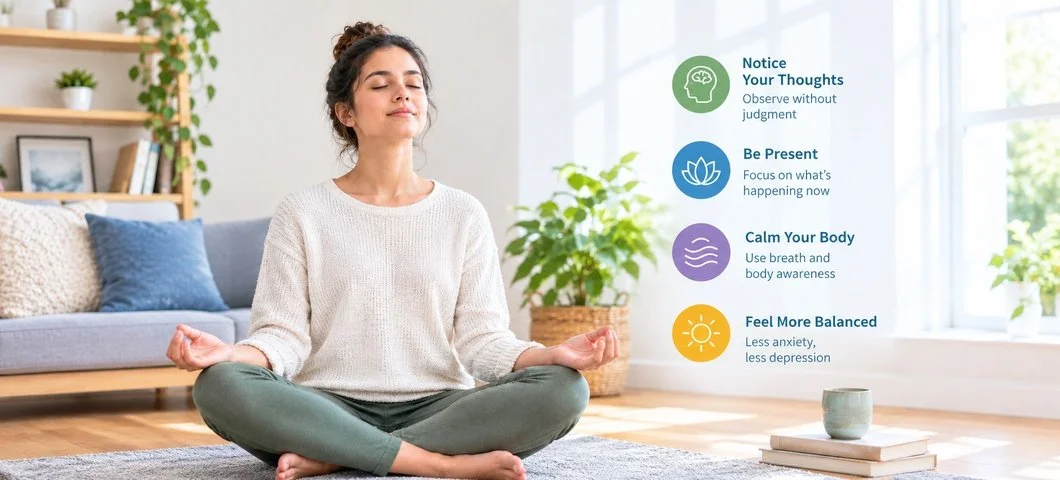
Mindfulness-based therapy reduces anxiety and depression by teaching you to notice your thoughts and feelings without getting swept away by them. Instead of fighting worry or low mood, you learn to observe it, let it pass, and return your attention to the present. Over time, this steadies the stress response and loosens the grip of anxious and depressive thinking.
It blends simple mindfulness practices, like focused breathing and body awareness, with proven therapy methods. The goal is not to empty your mind or force yourself to feel calm. It is to change your relationship with hard thoughts, so they carry less weight.
Research suggests that mindfulness-based cognitive therapy can lower the chance of depression returning for people who have had several episodes. Many people also report feeling less anxious and more grounded. It works well on its own or alongside adult mental health therapy in Vancouver, WA.
What Is Mindfulness-Based Therapy?
Mindfulness-based therapy is a type of talk therapy that adds mindfulness practice to the work. Mindfulness means paying attention to the present moment on purpose, without harsh judgment. When paired with therapy, it becomes a practical tool for managing emotions.
Two common forms are mindfulness-based cognitive therapy, or MBCT, and mindfulness-based stress reduction, or MBSR. MBCT is often used to help prevent depression from coming back. MBSR is widely used for stress and anxiety.
Both teach the same core skill: noticing what is happening inside you and choosing how to respond. To see where this sits among your options, our guide to the types of therapy for mental health gives a helpful overview.
These programs were first shaped in university and hospital settings, then adapted for everyday clinics. Many follow a structured plan over several weeks, though a therapist can also weave the tools into regular sessions. The format is flexible enough to fit different needs and schedules.
How Does Mindfulness Reduce Anxiety?
Anxiety often runs on “what if” thinking. Your mind races ahead to future problems, and your body reacts as if the danger is real right now. Mindfulness gently interrupts that loop.
By bringing your attention back to the present, you remind your body that this moment is safe. Slow, focused breathing signals the nervous system to settle. The racing heart and tight chest often ease as a result.
You also learn that a thought is just a thought, not a fact or a command. That small shift takes power away from anxious predictions. Body-based support such as the Cognitive Behavioral Therapy (CBT) , Yoga and mindful movement can pair well with this, helping the body reach a calmer baseline.
With practice, mindfulness can also improve sleep, which anxiety often disrupts. A calmer body at night makes it easier to rest. Better sleep, in turn, tends to lower anxiety the next day.
Struggling With Constant Worry or Low Mood?
Reach out to the Wonder Tree team to talk about a calmer path forward.
How Does Mindfulness Help With Depression?
Depression often feeds on rumination, the habit of replaying negative thoughts over and over. This cycle can pull moods lower and lower. Mindfulness helps you notice when it starts and step out of it sooner.
Rather than believing every harsh thought about yourself, you learn to watch these thoughts come and go. That distance makes them feel less true and less heavy. Small moments of relief can slowly add up.
Mindfulness also encourages gentle self-kindness, which many people with depression struggle to feel. Learning to treat yourself with a little more patience can soften the inner critic. Over time, that kinder tone becomes easier to reach.
This is why MBCT is often used to help prevent depression from returning. It gives people early warning signs to watch for and tools to respond before a dip becomes a full episode. If you are unsure whether you are in a low mood or something else, our post on the difference between burnout and depression can help.
What Techniques Are Used in Mindfulness-Based Therapy?
The practices are simple and can be learned by anyone. They do not require special equipment or hours of free time. Common techniques include:
Breath awareness: resting your attention on the natural rhythm of your breathing.
Body scan: slowly noticing sensations from head to toe to release tension.
Watching your thoughts: observing thoughts pass by without grabbing onto them.
Grounding: using your senses to anchor yourself in the here and now.
Mindful daily habits: bringing full attention to simple acts like eating or walking.
A therapist guides you through these at first, then helps you use them on your own. Most take just a few minutes a day. Practiced regularly, they can change how you handle stress over time.
Want to learn these tools with support? Book a first appointment with a Wonder Tree provider in Vancouver, WA.
What Does a Mindfulness-Based Therapy Session Look Like?
A session usually mixes conversation with short, guided practice. You might talk about a stressful week, then try a brief breathing exercise together. The therapist helps you connect what you feel to what is happening in your body and mind.
You will often get small practices to try at home between sessions. These are gentle, not homework to stress over. The idea is to build the skill a little at a time, so it feels natural rather than forced.
There is no pressure to be “good” at mindfulness. A wandering mind is normal, and noticing that it wandered is part of the practice. The pace is set with you, at a level that feels doable.
Early sessions often focus on learning one or two simple practices well. As you grow more comfortable, the therapist may add new tools or link them to specific triggers. Progress is gradual and built on small, steady wins.
How Is It Different From Regular Talk Therapy?
Standard talk therapy focuses on understanding your thoughts, history, and patterns through conversation. It is a strong approach for many concerns. Mindfulness-based therapy keeps that value and adds present-moment practice.
The difference is the focus on how you relate to your thoughts, not just their content. You spend time building the skill of stepping back and observing. This can be especially useful for worry and low mood that keep circling.
It also shares roots with cognitive therapy, since both look at unhelpful thinking. To compare it with a more thought-based method, our guide to how CBT works shows the overlap and the differences.
Who Can Benefit From Mindfulness-Based Therapy?
Mindfulness-based therapy may help adults dealing with anxiety, recurring depression, or high stress. People who feel stuck in worry or self-critical thinking often find it useful. It can also support better sleep and focus, along with a steadier mood through busy or hard days.
It is not only for adults. Older children and teens can learn simple mindfulness tools too, often through child therapy in Vancouver, WA. Families sometimes practice together, and family therapy in Vancouver, WA can help a whole household build calmer habits.
Mindfulness is not a fix for everyone, and that is okay. Some people prefer other methods, and some do best with a blend. A good provider will help you find the right mix for you.
Mindfulness-Based Support in Vancouver, WA
At Wonder Tree Developmental Psychology, located at 1603 Officers Row in Vancouver, WA, care is warm, practical, and shaped around you. Sessions focus on tools you can use in real life, not just ideas to think about.
Support is available in person and through virtual therapy with a PSYPACT-authorized psychologist, so you can meet in the way that suits your week. Whether you are new to mindfulness or have tried it before, a provider can meet you where you are. There is no experience needed to begin, only a willingness to try.
Frequently Asked Questions
-
Yes. Studies suggest mindfulness-based approaches can reduce anxiety and help prevent depression from returning. As with any therapy, results vary from person to person, so a qualified provider can help you set realistic expectations.
-
No. Most practices take only a few minutes a day. The benefit comes from doing them regularly, not from long sessions.
-
Not necessarily. Mindfulness-based therapy often works best alongside other care, not in place of it. Never change or stop a prescribed treatment without talking to your provider first.
-
That can happen at first, and a trained therapist adjusts the pace to keep it gentle. If you ever feel unsafe or have thoughts of harming yourself, please contact a qualified provider or a crisis line right away.